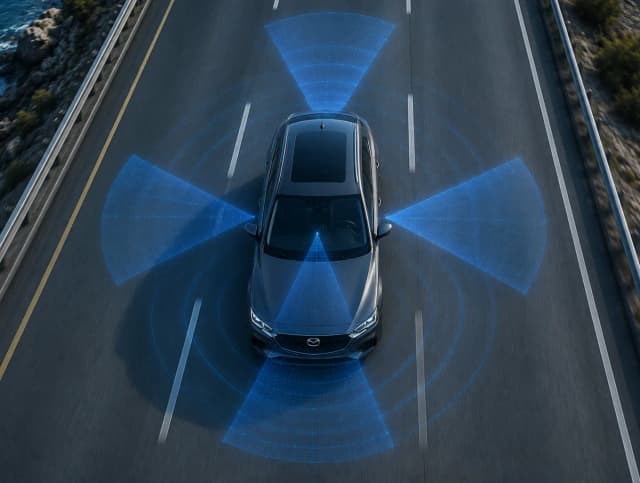
How our Mazda ADAS Calibration Works
1. Pre-Calibration Inspection
Before any calibration adjustment is made, our Mazda-trained technicians complete a thorough MDS-guided vehicle assessment:
Connecting Mazda Diagnostic System (MDS) software to read and catalogue all stored fault codes in the i-ACTIVSENSE, SBS, and cruise control modules.
Physically inspect the forward-sensing camera mounting bracket on the windshield interior for displacement, bracket cracking, or lens soiling.
Examining the millimetre-wave radar housing on the front bumper or lower grille for impact damage, rotational shift, or water ingress.
Inflating all four tyres to Mazda's model-specific pressure values to confirm the vehicle sits at the correct calibration ride height.
Verifying the Mazda's steering angle sensor is at centre-lock and confirming the vehicle is resting on a flat, stable calibration floor.
2. Types of Mazda Calibration Methods
Static Indoor Calibration
The Mazda is positioned in a controlled, evenly lit calibration bay set up to Mazda MDS dimensional requirements.
A Mazda-specific monocular camera target chart is placed at the manufacturer-specified distance and height directly ahead of the forward-sensing camera.
MDS connects via the OBD-II port and executes the automated calibration command, resetting the camera's pitch and yaw to Mazda's factory reference values.
The updated reference geometry is written back to the i-ACTIVSENSE control module and confirmed by MDS.
Dynamic Road Calibration
The Mazda is driven by a qualified technician at 40 to 80 km/h on roads with clear, well-maintained lane markings.
MDS monitors live i-ACTIVSENSE outputs: lane boundary tracking, forward object detection range, and Smart Brake Support trigger distance.
Confirms that Radar Cruise Control target acquisition and Lane-keep Assist steering authority meet Mazda's dynamic performance benchmarks.
3. System-by-System Calibration Process
Forward-Sensing Camera (Upper Windshield)
The MDS chart target resets the monocular camera's vertical and horizontal angles to Mazda's longitudinal vehicle axis.
Restores accurate Smart Brake Support pedestrian detection range and Lane Departure Warning lane-edge sensitivity.
Confirmed in the subsequent dynamic drive with live MDS data verifying Lane-keep Assist centring accuracy.
Millimetre-Wave Front Radar (Lower Bumper / Grille)
A dedicated alignment frame orients the radar beam to track exactly level and parallel to the road surface ahead.
This alignment directly controls Radar Cruise Control's ability to accurately measure and maintain the set following distance.
Recalibrated Smart Brake Support radar thresholds ensure the system calculates collision risk from a correct forward reference.
Blind Spot Monitoring Radar (Rear Bumper)
Rear corner BSM radar modules are calibrated to maintain the correct side-coverage detection arc on each side of the vehicle.
Rear Cross Traffic Alert sensor sweep verified for the correct lateral detection zone during low-speed reversing.
360-Degree View Monitor (Where Fitted)
Multi-camera image boundaries are stitched and realigned to eliminate perspective distortion in the overhead parking display.
Parking guideline overlays confirmed to accurately represent the Mazda's turning radius and vehicle perimeter.
4. Post-Calibration Verification
Following all i-ACTIVSENSE calibration stages, our technicians complete the Mazda-specific sign-off process:
A full MDS re-scan of all i-ACTIVSENSE, SBS, and cruise control modules to verify zero remaining fault codes.
A final on-road validation drive confirming Smart Brake Support, Radar Cruise Control, and Lane-keep Assist performance in live conditions.
Comprehensive digital records of all calibration data, MDS session files, software version details, and technician certification.
Issuance of a formal i-ACTIVSENSE calibration compliance certificate to the vehicle owner for insurance, dealer log book, and warranty records.
Why Mazda Owners Choose ADAS Melbourne Calibration
Complete i-ACTIVSENSE restoration – Smart Brake Support, Radar Cruise, Lane-keep Assist, and BSM – all addressed in a single visit.Precise elimination of Smart Brake Support phantom activations and i-ACTIVSENSE dashboard warnings.Mazda MDS software delivers dealership-level calibration accuracy for every i-ACTIVSENSE-equipped model.Efficient service across the full Mazda range, from the Mazda2 to the CX-9 seven-seater.A formal compliance certificate issued after every service for insurance, log book, and resale documentation.